“King Kong” as a Horror Film for the Imperialist Age

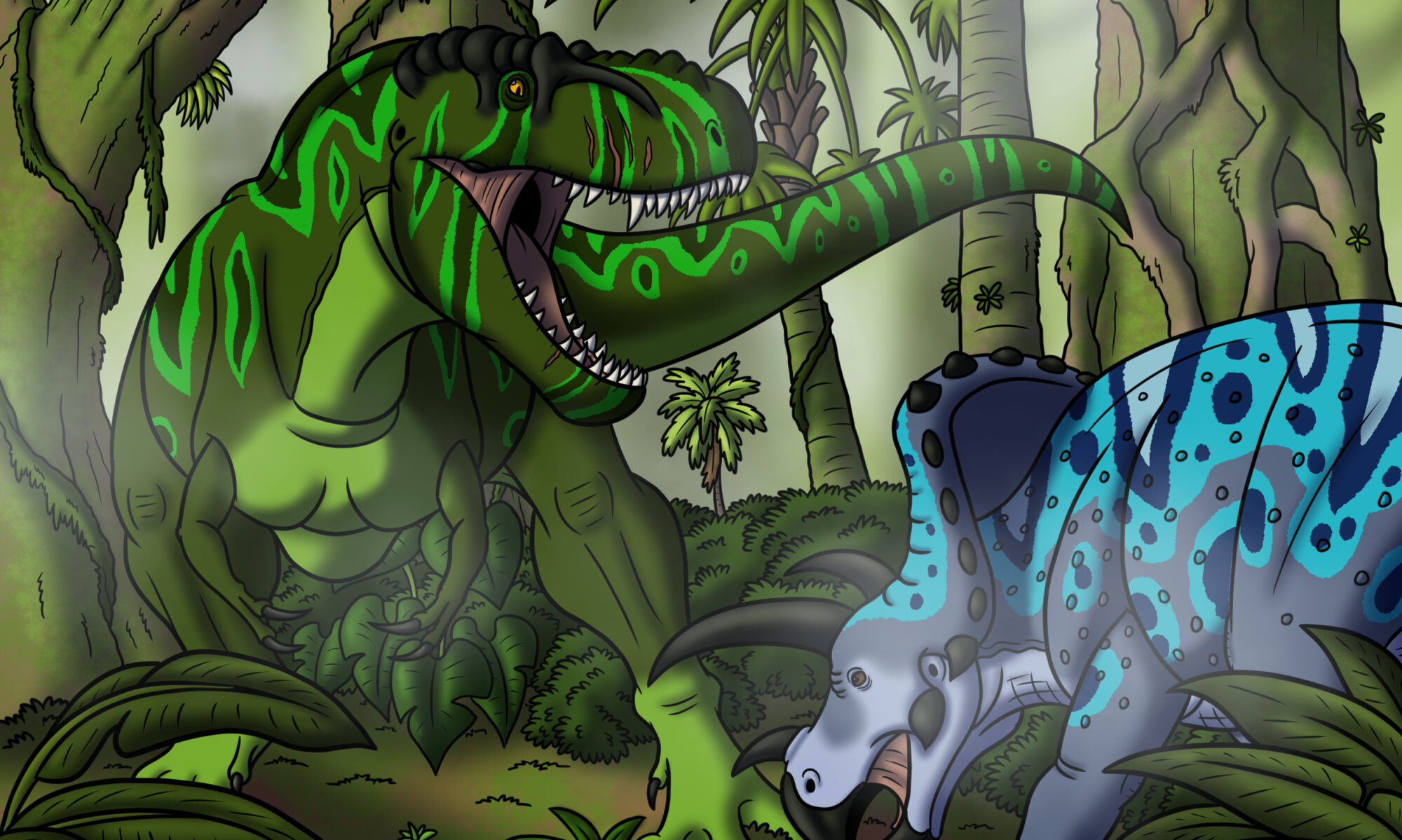
King Kong battles a Tyrannosaurus rex in the rainforests of Skull Island

In the book Guide for the Film Fanatic (1986), author Danny Peary declares the 1933 film King Kong “the greatest of all horror films” with “masterly special effects”. To modern audiences, even those that appreciate the original King Kong as an important landmark in the history of cinema, this might appear a hyperbolic assertion that sorts it into the wrong genre. While the film has more than its fair share of violence, bloodshed, and screaming characters, its almost non-stop action and bold fanfare score could not differ more from the eerie, quieter style of today’s entries in the horror genre.

Nonetheless, there can be no dispute that moviegoers back in the 1930s found it pretty scary. For example, one critic from the Los Angeles Times called it a “first class nightmare” and warned prospective viewers that “some of the horrors, it must be said, are a little strong.” (Morton 2005).

So what was it about King Kong that made it a horror film in the eyes of 1930s audiences? I will argue that this original perception is rooted in the film’s presentation of subject matter that the generation that created and consumed it, most especially Europeans and Americans of European heritage, would have generally perceived as horrific as a product of the imperialist culture they had partaken in.

First there is the subject of Kong himself, who for all intents and purposes is a gorilla that has evolved to gigantic proportions. Back when the film was made, few if any people in the European cultural sphere understood gorillas as the relatively peaceful, primarily vegetarian relatives of humanity studied by Dian Fossey (1983) and other primatologists. Beginning in the 19th century, the common European stereotype of gorillas was one of violent brutes prone to abducting women and attacking hunters in the Central African rainforest (Brightwell 2014). Such portrayals of course had less in common with these animals’ actual behavior than the Victorian-era appetite for exotic sensationalism and prejudices about how “subhuman” beings (including non-European people, as will be explained later) would act.

The character of Kong is nothing if not a scaled-up, one-dimensional embodiment of these originally Victorian myths about gorillas. His oversized fangs and bug-eyed glare, especially when contrasted with the dark coloring of his body in the black-and-white film, convey an appearance of predatory and inhuman menace further supported by his homicidal behavior towards almost every living thing he comes across. Not only does he kill every prehistoric beast that challenges him on the island, but he tramples and slaughters some of the local population and their dwellings after breaking through their gate, not to mention the equivalent carnage he causes when he escapes in New York City.

The only living creature he does not treat with violence on first impulse is the character of Ann Darrow (Fay Wray), which he carries off after the islanders offer her as a sacrificial “bride”. However, given that the gorilla myth that Kong represents stated that they were prone to abducting women from “higher” races, it is doubtful that Kong’s treatment of Darrow was meant to be sympathetic or endearing. At most it embodies the film’s explicitly stated theme that beauty has a way of taming and even killing the beast within men.

For all the terror that he causes, Kong is by no means the only character in the film that audiences in the 1930s would have regarded as scary. He shares his jungle island with a variety of oversized dinosaurs and other prehistoric creatures that surpass even him in scale. These menace both Ann Darrow when she is in Kong’s possession and the team of rescuers that pursue her during the middle act of the film. It is not only the carnivorous Tyrannosaurus rex which Kong defeats in battle that poses a threat either, for even supposed plant-eaters like the Stegosaurus and Brontosaurus are seen attacking the human characters without apparent provocation. The wanton aggression of all these animals, whether flesh- or plant-eating, reinforces the theme that the island’s jungle is a particularly dangerous and uncivilized place even if one subtracts the brutality of Kong himself from the picture.

And then there is the matter of the island’s human inhabitants. Although the island itself is said to be located off the western coast of Sumatra in Southeast Asia, the islanders are all played by African-American actors and so are depicted as having dark skin and tightly curled hair. I consider it most likely that they are meant to represent a population of Melanesian or Negrito affinity. Regardless, they too were probably intended to be objects of horror for the film’s contemporary audience when you consider how they treat the character of Ann Darrow.

In the 1930s, the archetype of “subhuman” males lusting after women from “higher races” would have been forced not only onto gorillas and other non-human primates, but onto men from darker-skinned racial groups. The racist belief that men of African descent in particular found European women more desirable than their own and so pursued them aggressively was a major source of paranoia among European-Americans (Pilgrim 2000). Even black men who so much as whistled after white women could be savagely lynched.

To audiences of European descent watching King Kong in 1933, the scene where the islanders’ chieftain (Noble Johnson) offers six of his own population’s women in exchange for Ann Darrow must have appeared as ominous foreshadowing. And once a troop of the islanders climbs onto the boat to abduct Ann Darrow, wrapping their dark-skinned and bracelet-adorned arms around her, we can imagine how these same viewers’ racial fears would have been titillated. Of course, that the islanders bang drums interpreted by the European-American visitors as ominous, dress in stereotypical tribal attire such as loincloths and face-paint, and have a tradition of sacrificing young women to Kong further plays into European perceptions of dark-skinned peoples as uncomfortably foreign, superstitious, and barbaric. As symbols of faraway savagery, they would have counted as another element of horror in King Kong.

To understand why giant gorillas, dinosaurs, and Melanesian “savages” would have all been understood as horrifying, we need to consider the cultural context that begat the film King Kong. In the 1930s, European countries still controlled large swathes of tropical regions such as Africa and southern Asia which they had conquered over the course of the 19th and earlier 20th centuries. To justify their exploitative imperial projects, Europeans exaggerated the inherent savagery of the human and animal inhabitants in these regions, saying it was the “white man’s burden” to civilize them. Africa for example was stereotyped as a “Dark Continent” populated by cannibalistic natives and monstrous wildlife. Associated with this was the perception that tropical areas of the world represented a throwback to an earlier and more “primitive” era, with the indigenous people even claimed to represent an evolutionary “missing link” between Europeans and non-human primates.

The island setting of King Kong is the perfect realization of this imperialist vision of the tropical world. The presence of dinosaurs and other Mesozoic fauna creates the impression that the island is an anachronistic relic from a bygone era, a message reinforced by the Melanesian population with their barbarous and superstitious customs. The character of Kong himself, a subhuman brute who abducts women and brutalizes everyone else in his path, is a classic example of how post-Victorian Europeans and European-Americans envisioned gorillas and other creatures of the African wilderness. It is as if all the beliefs these audiences would have held about distant tropical countries have been rolled into one place that exemplifies their supposed worst attributes.

This is the reason King Kong counts as a horror film. The perception of horror in the film would have depended on the prejudices that Europeans and European-Americans would have developed and nurtured about the tropical areas they had conquered and exploited. By portraying the targets of European imperialism as innately dangerous and uncivilized, the film would have both aroused feelings of terror in its intended audience and rationalized the imperial projects that benefited them. It was very much an experience of horror for the age of imperialism.

Works Cited

Brightwell, Eric. “Gorillasploitation — Giant Gorilla Movies.” Amoeblog. July 8, 2014. Accessed November 13, 2016. http://www.amoeba.com/blog/2014/07/eric-s-blog/gorillasploitation-giant-gorilla-movies.html.

Cooper, Merian C. and Ernest B. Shoedsack. King Kong. RKO Pictures, 1933.

Fossey, Dian. Gorillas in the Mist. Boston, MA: Houghton-Mifflin, 1983.

Morton, Ray. King Kong: The History of a Movie Icon from Fay Wray to Peter Jackson. New York: Applause Theater and Cinema Books, 2005.

Peary, Danny. Guide for the Film Fanatic. New York: Simon & Schuster, 1986.

Pilgrim, David. “The Brute Caricature.” Jim Crow Museum. November 2000. Accessed November 13, 2016. http://www.ferris.edu/jimcrow/brute/.
Q&A for “Priestess of the Lost Colony”

This is an interview I did as part of my marketing for my upcoming novel Priestess of the Lost Colony. All questions were prepared by fellow author Robert Yehling (you can check out his website here). I must warn you that there might be some minor spoilers in this exchange.

Continue reading “Q&A for “Priestess of the Lost Colony””

White Lion of the Trinity River

Texas, 1875 A.D.

Penelope Jenkins held her brass-framed binoculars to her eyes and peered at the steamboat resting on the southeastern horizon. Even within the evening mist, the vessel’s blocky bright white form stood out against both the deep violet sky and the dark waters of the lower Trinity River, as did the lanterns that twinkled along its tiered decks. On the side of its hull read the words “The Lion’s Den” in thick black lettering.

Penelope could not resist a quiet snicker to herself. “If that ain’t his hideaway, I don’t know what would be.”

She dismounted her black stallion Ramses, hitched him to one of the oak trees that fringed the floodplain, and took out both her revolver and rifle from holsters attached to his saddle. Weaving her svelte figure through the thick reeds along the riverbank, she made sure to walk on tiptoes so that her boots wouldn’t squish too loudly in the mud.

The closer Penelope drew to the steamboat, the more audible was the vulgar banter and laughter of men on the bow of the boat’s uppermost deck. Amidst this played music like the squealing of a fiddle, the staccato twanging of a mandolin, and the buzzing of a harmonica. She could even catch a faint whiff of tobacco smoke mingling with the sweet scent of liquor. Whatever occasion these pirates were celebrating, they sure liked to party.

Looking through the binoculars again, she scanned the length and height of the ship for the likeness of the White Lion as she remembered it from his wanted poster. She could find him nowhere, not even among the noisy throng of revelers. Penelope recalled from the poster’s description that he had once been a gentleman of refined taste, so perhaps he would not associate with his own minions by dancing among them. He might have retired to one of the fancier cabins inside.

Regardless, Penelope’s plan from that point on was nothing elaborate. She would wade up to the steamboat’s stern, possibly climbing up its paddle wheel like a ladder, and sneak her way around until she found her prey and end his career of robbery and terror the way he deserved. In an ideal situation, she’d be able to accomplish all this and escape before the Lion’s men knew what hit them, but failing that…well, a few drunken pirates couldn’t be too difficult to take on or evade. Could they?

Something ice-cold and metallic prodded the dark brown skin on the back of Penelope’s neck.

Continue reading “White Lion of the Trinity River”

The Love Potion (A Fairy Tale)

It would not be quite accurate to say Elizabeth Blake had been born with a silver spoon in her mouth. A spoon of pure gold, encrusted with diamonds, would do her upbringing more justice. All her life she had luxuriated within her family’s mansion of dazzling white marble out in the countryside, supported by the labor of their cotton plantation’s loyal and industrious workforce. Indeed, the Blakes had amassed so much wealth that finding a suitable husband for their darling princess Elizabeth was like mining for gems in a pigsty.

True, armies of men would flock to the Blake estate to court her, showering her with praise for her ginger locks, fern-green eyes, and cherry-red lips. But a proper belle like Elizabeth cared little for all those smelly, sun-weathered rednecks, and her old father cared for them even less. It was not until after her twenty-fifth birthday had passed when one worthy young gentleman, an enterprising doctor by the name of Thomas Henderson, had moved into her neighborhood from the north.

As they say, a bachelor in possession of a good fortune is highly wanted as a husband by women like Elizabeth Blake. But every time she and Mr. Henderson crossed paths, despite her best efforts to grin and bat her eyelashes at him, the boy would simply smile back and continue with his business. At most Thomas would nod and compliment her dress upon request. This she found most peculiar; how could the one marriageable man she had ever seen not fall for her charms like all those hicks before him?

All her life, every time Elizabeth had asked for something, she would get her way no matter what. She would do anything she could to win this handsome newcomer over, even if it meant venturing deep into the dark overgrown swamp that stretched beyond her estate. For within that wetland lived a young voodoo priestess named Izegbe. Elizabeth would never let herself touch this savage heathen’s sooty hand, but desperate times called for desperate measures.

“O Priestess of Voodoo, do you know how to make a man fall in love with me?” Elizabeth asked. “I love no man other than Thomas Henderson, yet I fear he doesn’t love me.”

The priestess bit her lip at first, but then smiled before fetching a flask of clear liquid from her medicine cabinet. “Take this love potion free of charge, my sweet Miss Blake. Take a few strands of your hair and mix them into it, and then give it to the man you love. One drink will make him fall for you.”

Elizabeth went home to do as the priestess instructed. She opened the flask, wincing from the potion’s awfully pungent odor, and stirred strands of her own hair into it. She cackled with eager glee as she prepared the potion thus.

The next evening, Elizabeth went down to the local bar where Thomas was enjoying his usual drink after a hard day’s work. She handed to him the potion, wrapped with a glittery red ribbon as if it were a Christmas present. “It’s a special gift just for you, Dr. Henderson.”

Dr Henderson scratched his hair with befuddlement, but shrugged and opened the flask. But after he sniffed its contents, he did not take even one sip.

“Why, this is none other than chloral hydrate—a common date rape drug!” he roared. “I know what you’re up to, Miss Blake! Someone call the marshal!”

“No! I didn’t mean to rape you, Thomas,” Elizabeth said. “I was tricked by that sooty whore Izegbe!”

At that very moment Izegbe, who stepped forth from the shadows. “It was for good reason. You wanted a way to manipulate his feelings to benefit yourself. That, Miss Blake, is the textbook definition of date rape, and I had to trap you for it! And besides, Thomas is seeing me.”

As the police marched in to drag Elizabeth Blake away, the last she saw of Thomas Henderson was Izegbe embracing him with ebony arms and kissing him with a lover’s passion.

Why Tyrannosaurs Probably Didn’t Have Feathers After All

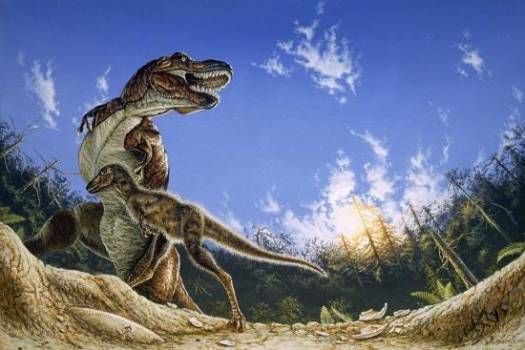
Artwork by Michael W. Skrepnick, showing a mother T. rex with its downy hatchling

I admit it, nine-year-old me would have cried at the idea of Tyrannosaurus rex, my all-time favorite dinosaur, sporting a coat of feathers like a bird.

I first encountered the above illustration in an issue of National Geographic back at that tender age. The issue had a whole article on then-recent discoveries of dinosaur fossils sporting impressions of feathers from China, with numerous model reconstructions and other artwork depicting how the animals would have looked in life. Mind you, I was already aware that some theropod (or “meat-eating”) dinosaurs were close relatives of modern-day birds, and that the “first bird” Archaeopteryx demonstrated a visible link between the two groups. What the new Chinese fossils demonstrated was that the prevalence of feathers among theropods went beyond Archaeopteryx and its immediate ancestors and covered groups once thought to be scaled like other dinosaurs, such as dromaeosaurids (“raptors” such as Velociraptor and Deinonychus), oviraptorosaurs (Oviraptor), and compsognathids (a family including, well, the tiny Compsognathus).

Seeing Velociraptor, the intimidating antagonists of Jurassic Park, portrayed as feathered like birds was already enough to ruffle my feathers (pun very much chosen with intent). But the most offensive illustration in that issue by far, in my juvenile eyes anyway, was the one suggesting that Tyrannosaurus and its cousins in the tyrannosaurid family would have possessed a feathery coat as well. It didn’t matter that the illustration contrasted a downy hatchling with its scaled adult. The very idea of my favorite dinosaur, lord of the jungle of Late Cretaceous North America, ever having the telltale body covering of a lowly, cowardly bird seemed a major downgrade. It was heretical enough to put me off the idea that any dinosaurs evolved into birds at all.

Twenty years have passed, and I have matured enough to recognize that some so-called “non-avian” dinosaurs did, indeed, have feathers, and that all of today’s birds represent an offshoot of these dinosaurs. The preponderance of evidence so far does suggest that, contra the Jurassic Park movies, that dromaeosaurids like Velociraptor would have been feathered by default, as would the flock of Gallimimus seen in the first film’s stampede scene (at least as shown by new fossils of its cousin Ornithomimus). I cannot dispute this, nor do I even mind it anymore.

My feelings about feathered tyrannosaurs, on the other hand, have come full circle. Beginning in the early 2010s, I have warmed up to the idea and was eagerly drawing full feathered coats on them between 2012 and 2013. It was after that period of my life that my skepticism of the concept returned. In the years since, I have lost any remaining love for it and, if anything, have grown even more sick of it than I ever was as a child.

This time, however, I have good reason to believe that neither Tyrannosaurus rex nor the other members of the family Tyrannosauridae ever had feathers. And not only because they look better without them.

Continue reading “Why Tyrannosaurs Probably Didn’t Have Feathers After All”

The Demon Beneath the Dome

A woman climbed onto the bough of a kapok tree, which twisted up from the treetop canopy. Her lissome dark umber figure, clad with a barkcloth skirt and halter-top, sparkled with droplets of perspiration beneath the hot glow of the sun piercing through the overcast sky. She raised her hand over her eyes, surveying the green ocean of jungle as it rolled in choppy waves all around her high vantage.

To the east rose a jagged range of overgrown crags, which ran in a ring like a caldera. Covering the basin within was a vast, terraced dome glimmering of corroded gold, with a circular hole in its summit. Under the shadow cast by the crater walls, the green-stained spires and roofs of ruined masonry poked through the jungle, but there appeared no evidence of a living settlement in the proximity of these ruins.

The woman shuddered slightly as she tightened her grip on her perch. She had heard the legends, but never considered them anything more than village storytellers’ way of frightening children into good behavior. Neither had she imagined that she would ever venture within sight of a place like they had described.

Dinanga, huntress of the village of Mungu, had spent the better half of the past moon-cycle searching for her younger sister Kazadi. The memory of the girl’s abduction, with men in blood-red loincloths lunging out of the undergrowth to seize and drag her away, had haunted Dinanga’s every dream with a vivid clarity that never faded. She would have taken those men for common marauders had she not tracked them all the way to such mysterious ruins. If the old myths had spoken the truth all that time, an even more terrible fate would await Kazadi.

Within the jungle to the southwest, someone screamed.

Continue reading “The Demon Beneath the Dome”

Mayhem in the Menagerie

This is meant to be a sequel to an earlier story of mine titled The Battle Roar of Sekhmet, which you can also read on this website’s blog.

Reference sheet for Takhaet, an Egyptian warrior who is the protagonist of my short stories “The Battle Roar of Sekhmet” and “Mayhem at the Menagerie”.

Egypt, 1345 BC

I crouched at the edge of our raft of woven papyrus and peered down at the dark green-blue water with harpoon in hand. Near the reeds along the river’s edge, there drifted a plump tilapia almost two feet in length. I licked my lips at the thought of chowing down on its succulent flesh. The fish would feed both Nebet and I for at least one whole day, if not two.

I stabbed after the tilapia. It escaped by darting over to the reeds where it vanished. Under my breath, I cursed Sutekh’s mischief for hexing my aim yet again. The aardvark-faced Lord of Chaos had caused me nothing but grief and disappointment since we had set out on the day’s expedition this morning.

Nebet, my niece of ten years, held up a line of rope with a hook that transfixed a tiny morsel of mutton. “You sure you don’t want to use the lure, Aunt Takhi?”

I gave her a half-serious scowl while accepting her lure with a grumble. I would always protect the child with my life, but I had to admit that she had grown into quite the smart mouth over the last few years.

I plopped the hook into the water. “I must have underestimated how rusted my fishing skills have grown. When I was your age, Nebet, I would put all the boys to shame at this!”

“Maybe find yourself a man who would do the fishing for you?” Nebet asked. “There should be plenty to go around, and most of them seem to like you.”

I raised my eyebrow. “How would you know that?”

“Whenever you go by, they always seem to look at you twice. And you know that old Vizier Ay from way back? I remember he sounded like he wanted you for himself.”

The memory of that shriveled husk of a man, that lecherous lackey of the false Pharaoh, flooded the inside of my mouth with a sour flavor. The passage of five years since we last crossed paths had not softened my distaste for him and his minions. I would sooner swim with crocodiles than occupy the same room as him.

“You have seen much more than any child your age should see, my little niece,” I said. “As far as men are concerned, the problem I have isn’t that I can’t attract any. If anything, they like me more than I like any of them.”

“Then maybe you like women more, Aunt Takhi?” Nebet said. “Maybe you could have another woman in place of a man?”

I rolled my eyes with a laugh. “No, no, I prefer men in the way you mean. It is only that I haven’t found a man worthy of our house. Maybe I should consult the priestesses of Hetheru. They might know why.”

For most of my life, it was Sekhmet I had served more than any of the other old gods or goddesses. Yet the stories held that Sekhmet, she of the lion mask and blood-stained gown, was in truth another guise of the loving bovine Hetheru. Perhaps calling upon my patron goddess would convince her to shift forms and answer my prayer for love.

“I thought there weren’t any more priestesses of Hetheru?” Nebet said. “The Pharaoh shut all their temples down long ago. Don’t you remember?”

She was right. Too often, my mind drifted back to the better days of my youth, before the false Pharaoh had assumed the throne and desecrated everything his righteous father had built and maintained. I had to return to the present, not think too much of the past or future, and get back to fishing.

I checked our hook beneath the water’s surface. The bait had disappeared, yet there was no fish still attached. They must had figured how to bite off the meat without getting themselves caught. How foolish I had been to let myself get distracted!

A wave rocked our raft from the side. Over by the far bank of the river, a man screamed while splashing and thrashing his arms in the air. Zipping through the water towards him was the bumpy, olive-brown wedge of a crocodile’s head.

Continue reading “Mayhem in the Menagerie”

Dribble Like Me

It’s a ball game between two cultures. If our heroine loses, she might be put to death!

The sunset lent a warm, almost cozy glow to the stacks of scarlet-washed terraces that supported the buildings of Mutul. It was a city stuffed with more pyramids than any place Neith-Ka recalled from her native Khamit. Her people might have buried their Pharaohs in monuments of equal or even more mountainous scale, but then these peculiar Mayabans would lay every one of their structures on top of a stepped pyramid, none less than two stories high, with everyone having to hike up a succession of stone stairs to reach the summit.

Neith-Ka shook her foot to dull the pain chewing away at her tendons. Already the woven papyrus of her sandals had started to splinter apart from wear. The Khamitan people may have taken pride in the grandeur of their own monuments, but never would their architects dare subject anyone to so many tortuous steps. You weren’t even supposed to climb the royal tombs back home.

Huya, her high steward, clicked his tongue with a frown. “You could feign a good attitude, Your Highness.”

Neith-Ka drew in a deep breath through her nostrils. “I’ve done my best. Please show some understanding.”

“I saw you pouting. And, I swear by the scales of Ma’at, I heard you mutter a curse while shaking that leg. You don’t seem to remember that you’re representing your father, your family, and all the Black Land here, princess. I’ll see no more lip from you tonight!”

With another inhale, Neith-Ka straightened herself up and nodded to her steward. As he and their entourage of guards and servants marched up yet another ramp of steps, she huddled close behind while keeping her focus on their destination on top. Looking back down the pyramid’s height could only intimidate her further. Even more so with the lighter brown locals crowding behind her with the gawks of strangers who had never seen even one darker-skinned person their entire lives.

The lip of the stairway connected to a platform that supported a ring of rectangular buildings around a courtyard, all plastered with a blazing red base. Yet these were not monochrome edifices, for each had mounted on its walls and over its doorways elaborate reliefs of jade-plumed gods, snarling gold leopards (or were those called jaguars over here?), and the strings of complicated square images that constituted the Mayaban culture’s written language.

To think that foreigners claimed that Khamit’s hieroglyphs were impossible to read! No mortal could possibly even draw their Mayabic equivalents.

From one short and wide building at the far end of the complex floated a faint yet spicy odor, with thin trails of steam snaking out from tiny windows in the walls towards its left edge. Dark green curtains, splashed with reds, golds, and purples hung behind the gallery of square columns that supported the remainder of the building’s length. Standing in front were a pair of native guards, stocky men in padded cotton vests who parted their obsidian-fringed spears upon noticing the Khamitans’ arrival.

Huya bowed at the waist to both guards. “Excuse me, my good man, but where would His Majesty the Ahau and his family be?”

“Already inside, waiting with as much patience as they’ve got,” one of the guards said.

The second glanced at Neith-Ka from the corner of his eye. “And you’re the one he’s waiting on, I presume. Not so ugly as far as your kind goes, if a bit overcooked. I’d advise you to stay clear of his youngest daughter.”

Neith-Ka gave him a subtle smile to hide the prickling sensation that crept up her back. “I’ll…uh, keep that in mind…my undercooked friend.”

“Princess! What did I say?” Huya hammered the butt of his high steward’s staff twice on the stone pavement.

“Aw, give your woman a pass,” the first guard said. “She was only telling my friend to show more hospitality. Right, Yaxkin?”

Strutting away from the two guards as they argued with one another in the Mayabic language, Neith-Ka plunged herself through the curtains into the royal dining hall.

Continue reading “Dribble Like Me”

The Sultan of Finback Isle – Opening Excerpt

Cover illustration for my e-novelette “The Sultan of Finback Isle”, showing our heroes Abdullah and Monique Kalua being encircled by a hungry Dimetrodon.

A new novelette available in ebook form on the Amazon Kindle store!

Having broken off from the other continents two hundred and sixty million years ago, the landmass known as Finback Isle has protected a unique ecosystem in the equatorial Pacific older than the dinosaurs themselves. Only a near-extinct nation of Polynesian settlers, together with the crew of Ferdinand Magellan in 1520, have ever set foot on the island within the annals of human history. 

And then Ibrahim Fawal, a native of Casablanca turned controversial new Chief of Police in Los Angeles, decided to establish his private winter getaway there.

Enter Abdullah and Monique Kalua, a daring husband-and-wife team of FBI agents sent to investigate the LAPD’s accelerated record of corruption and brutality under Fawal;s leadership, including the shooting of Monique’s own close relations. Their mission is to penetrate Fawal’s secret lair and bring him to justice.

Not only must they brave treacherous jungle littered with Polynesian ruins and teeming with beasts from the late Paleozoic Era, but they must also contend with the armed officers of one of the most vicious men ever to head the police of Los Angeles…the Sultan of Finback Isle!

Continue reading “The Sultan of Finback Isle – Opening Excerpt”

Hunting for Womanhood

I wrote and revised this short coming-of-age tale for a creative-writing assignment back in the spring of 2013, during my studies at UCSD. The writing may be rough compared to more recent work I’ve posted here, but I’m still partial to the unique little world I created for it.

Mukondi Djata slipped out of her leather sleeping tent with a spear and machete in hand. A gold sliver of sunlight crept up from behind the eastern plains to stain the twilight sky red and warm the sleeping women’s camp. Despite this heat growing outside, streams of dread colder than spring water coursed within Mukondi’s veins. Her spear’s iron point ran longer than her feet, and she would need every inch of it for the test of womanhood that she would begin this morning.

The rest of the Djata clan’s camp stayed asleep in silence. Not even the most excitable of the little girls scampered between the tents before their older sisters, mothers, and aunts woke up yet. The crimson arrow-shaped head of Sambu the Allosaurus, the Djatas’ symbolic animal, emblazoned each tent. When she noted the emblem’s jagged teeth, Mukondi gulped down a mouthful of air. The last thing she needed now was yet another reminder of the First Hunt which lay just ahead for her.

The throaty and hoarse blare of a hollowed animal horn shattered the silence. “Mukondi? Are you coming?” It was her mother Dyese calling.

Mukondi jogged to the fat baobab tree which towered in the heart of the camp. Two other women, her mother and her elder cousin Azandu, awaited below the tree’s shade. Having reached her own womanhood six rainy seasons ago, Azandu looked exactly as Mukondi and every other Djata girl wished to look: tall and lithe, with firm muscles under skin as dark as a moonless midnight. Rings of fangs and claws from Azandu’s kills hung from her neck, something Mukondi also wished she could earn in years to come. As for Dyese, the hide shawl she draped over her shoulders marked her rank as the Djata clan’s matriarchal chieftain.

Dyese smiled as she patted Mukondi on the shoulder. “You can do it, my precious,” she said. “Oyosi Herself sees to it that you will.” She tilted her wizened face up to the sky where Oyosi Djata, the clan’s great ancestress, rested.

Mukondi pulled her mother’s hand off. “You told Nzinge that very same thing, didn’t you?”

“Don’t mention her again!” Azandu banged her spear’s butt against the ground. “You are smarter and wiser than your big sister ever was, Mukondi. You’ll succeed where she failed, trust me.”

A quivering Mukondi folded her arms together. “How can you feel so sure of that?”

Azandu groaned. “Look, do you want to be dropped off at a men’s village and grow crops in one place for the rest of your life? Or do you want to become a woman?”

“I am no man!” Mukondi pounded a fist onto her breasts.

“Then don’t whine like one. Now, while scouting last night, I spotted Sambu drinking from the river to the south.” Azandu pointed towards the southern horizon. “He might still prowl over there.” She laid her own hand on Mukondi’s shoulder. “When you meet him, you know what to do.”

“Aim for the breast or brain,” Mukondi recited. She sucked in a mouthful of air to swell her chest upward and smiled.

“One more thing before you leave, daughter.” Dyese pulled out from her hide belt the animal horn she had blown earlier and handed it to Mukondi. “It goes back to my mother’s mother. Blow it, and you shall lure Sambu towards you.”

“Isn’t that cheating?” Mukondi asked.

“Not at all, but use it sparingly,” Azandu said. “Blow it too many times together and Sambu will figure out what you’re up to.”

Mukondi slipped the horn under her own belt and bowed her head to Dyese. “I owe you so much for the gift, mother.”

Dyese wrapped her arms around her daughter in a gentle embrace. “You owe nothing at all. Now go forth on your First Hunt, Mukondi. You leave our camp a girl, but you shall come back a woman, with Sambu’s teeth in your hands. May Oyosi bless you.”

Mukondi hugged her mother back with all her strength while more tears dripped from her eyes. This could have been the last time in their whole lives that they would see each other. Mukondi rested her head against Dyese’s breasts while her mother in turn stroked her dreadlocks.

“If I do not come back alive, I shall always remain in your memories, mother,” Mukondi said.

After Dyese withdrew her warm arms from her daughter, the chill returned to sting Mukondi’s blood. Nonetheless she jogged away from the camp, looking back only once.

Continue reading “Hunting for Womanhood”