“King Kong” as a Horror Film for the Imperialist Age

King Kong battles a Tyrannosaurus rex in the rainforests of Skull Island

In the book Guide for the Film Fanatic (1986), author Danny Peary declares the 1933 film King Kong “the greatest of all horror films” with “masterly special effects”. To modern audiences, even those that appreciate the original King Kong as an important landmark in the history of cinema, this might appear a hyperbolic assertion that sorts it into the wrong genre. While the film has more than its fair share of violence, bloodshed, and screaming characters, its almost non-stop action and bold fanfare score could not differ more from the eerie, quieter style of today’s entries in the horror genre.

Nonetheless, there can be no dispute that moviegoers back in the 1930s found it pretty scary. For example, one critic from the Los Angeles Times called it a “first class nightmare” and warned prospective viewers that “some of the horrors, it must be said, are a little strong.” (Morton 2005).

So what was it about King Kong that made it a horror film in the eyes of 1930s audiences? I will argue that this original perception is rooted in the film’s presentation of subject matter that the generation that created and consumed it, most especially Europeans and Americans of European heritage, would have generally perceived as horrific as a product of the imperialist culture they had partaken in.

First there is the subject of Kong himself, who for all intents and purposes is a gorilla that has evolved to gigantic proportions. Back when the film was made, few if any people in the European cultural sphere understood gorillas as the relatively peaceful, primarily vegetarian relatives of humanity studied by Dian Fossey (1983) and other primatologists. Beginning in the 19th century, the common European stereotype of gorillas was one of violent brutes prone to abducting women and attacking hunters in the Central African rainforest (Brightwell 2014). Such portrayals of course had less in common with these animals’ actual behavior than the Victorian-era appetite for exotic sensationalism and prejudices about how “subhuman” beings (including non-European people, as will be explained later) would act.

The character of Kong is nothing if not a scaled-up, one-dimensional embodiment of these originally Victorian myths about gorillas. His oversized fangs and bug-eyed glare, especially when contrasted with the dark coloring of his body in the black-and-white film, convey an appearance of predatory and inhuman menace further supported by his homicidal behavior towards almost every living thing he comes across. Not only does he kill every prehistoric beast that challenges him on the island, but he tramples and slaughters some of the local population and their dwellings after breaking through their gate, not to mention the equivalent carnage he causes when he escapes in New York City.

The only living creature he does not treat with violence on first impulse is the character of Ann Darrow (Fay Wray), which he carries off after the islanders offer her as a sacrificial “bride”. However, given that the gorilla myth that Kong represents stated that they were prone to abducting women from “higher” races, it is doubtful that Kong’s treatment of Darrow was meant to be sympathetic or endearing. At most it embodies the film’s explicitly stated theme that beauty has a way of taming and even killing the beast within men.

For all the terror that he causes, Kong is by no means the only character in the film that audiences in the 1930s would have regarded as scary. He shares his jungle island with a variety of oversized dinosaurs and other prehistoric creatures that surpass even him in scale. These menace both Ann Darrow when she is in Kong’s possession and the team of rescuers that pursue her during the middle act of the film. It is not only the carnivorous Tyrannosaurus rex which Kong defeats in battle that poses a threat either, for even supposed plant-eaters like the Stegosaurus and Brontosaurus are seen attacking the human characters without apparent provocation. The wanton aggression of all these animals, whether flesh- or plant-eating, reinforces the theme that the island’s jungle is a particularly dangerous and uncivilized place even if one subtracts the brutality of Kong himself from the picture.

And then there is the matter of the island’s human inhabitants. Although the island itself is said to be located off the western coast of Sumatra in Southeast Asia, the islanders are all played by African-American actors and so are depicted as having dark skin and tightly curled hair. I consider it most likely that they are meant to represent a population of Melanesian or Negrito affinity. Regardless, they too were probably intended to be objects of horror for the film’s contemporary audience when you consider how they treat the character of Ann Darrow.

In the 1930s, the archetype of “subhuman” males lusting after women from “higher races” would have been forced not only onto gorillas and other non-human primates, but onto men from darker-skinned racial groups. The racist belief that men of African descent in particular found European women more desirable than their own and so pursued them aggressively was a major source of paranoia among European-Americans (Pilgrim 2000). Even black men who so much as whistled after white women could be savagely lynched.

To audiences of European descent watching King Kong in 1933, the scene where the islanders’ chieftain (Noble Johnson) offers six of his own population’s women in exchange for Ann Darrow must have appeared as ominous foreshadowing. And once a troop of the islanders climbs onto the boat to abduct Ann Darrow, wrapping their dark-skinned and bracelet-adorned arms around her, we can imagine how these same viewers’ racial fears would have been titillated. Of course, that the islanders bang drums interpreted by the European-American visitors as ominous, dress in stereotypical tribal attire such as loincloths and face-paint, and have a tradition of sacrificing young women to Kong further plays into European perceptions of dark-skinned peoples as uncomfortably foreign, superstitious, and barbaric. As symbols of faraway savagery, they would have counted as another element of horror in King Kong.

To understand why giant gorillas, dinosaurs, and Melanesian “savages” would have all been understood as horrifying, we need to consider the cultural context that begat the film King Kong. In the 1930s, European countries still controlled large swathes of tropical regions such as Africa and southern Asia which they had conquered over the course of the 19th and earlier 20th centuries. To justify their exploitative imperial projects, Europeans exaggerated the inherent savagery of the human and animal inhabitants in these regions, saying it was the “white man’s burden” to civilize them. Africa for example was stereotyped as a “Dark Continent” populated by cannibalistic natives and monstrous wildlife. Associated with this was the perception that tropical areas of the world represented a throwback to an earlier and more “primitive” era, with the indigenous people even claimed to represent an evolutionary “missing link” between Europeans and non-human primates.

The island setting of King Kong is the perfect realization of this imperialist vision of the tropical world. The presence of dinosaurs and other Mesozoic fauna creates the impression that the island is an anachronistic relic from a bygone era, a message reinforced by the Melanesian population with their barbarous and superstitious customs. The character of Kong himself, a subhuman brute who abducts women and brutalizes everyone else in his path, is a classic example of how post-Victorian Europeans and European-Americans envisioned gorillas and other creatures of the African wilderness. It is as if all the beliefs these audiences would have held about distant tropical countries have been rolled into one place that exemplifies their supposed worst attributes.

This is the reason King Kong counts as a horror film. The perception of horror in the film would have depended on the prejudices that Europeans and European-Americans would have developed and nurtured about the tropical areas they had conquered and exploited. By portraying the targets of European imperialism as innately dangerous and uncivilized, the film would have both aroused feelings of terror in its intended audience and rationalized the imperial projects that benefited them. It was very much an experience of horror for the age of imperialism.

Works Cited

Brightwell, Eric. “Gorillasploitation — Giant Gorilla Movies.” Amoeblog. July 8, 2014. Accessed November 13, 2016. http://www.amoeba.com/blog/2014/07/eric-s-blog/gorillasploitation-giant-gorilla-movies.html.

Cooper, Merian C. and Ernest B. Shoedsack. King Kong. RKO Pictures, 1933.

Fossey, Dian. Gorillas in the Mist. Boston, MA: Houghton-Mifflin, 1983.

Morton, Ray. King Kong: The History of a Movie Icon from Fay Wray to Peter Jackson. New York: Applause Theater and Cinema Books, 2005.

Peary, Danny. Guide for the Film Fanatic. New York: Simon & Schuster, 1986.

Pilgrim, David. “The Brute Caricature.” Jim Crow Museum. November 2000. Accessed November 13, 2016. http://www.ferris.edu/jimcrow/brute/.
Q&A for “Priestess of the Lost Colony”

This is an interview I did as part of my marketing for my upcoming novel Priestess of the Lost Colony. All questions were prepared by fellow author Robert Yehling (you can check out his website here). I must warn you that there might be some minor spoilers in this exchange.

Continue reading “Q&A for “Priestess of the Lost Colony””

Why Tyrannosaurs Probably Didn’t Have Feathers After All

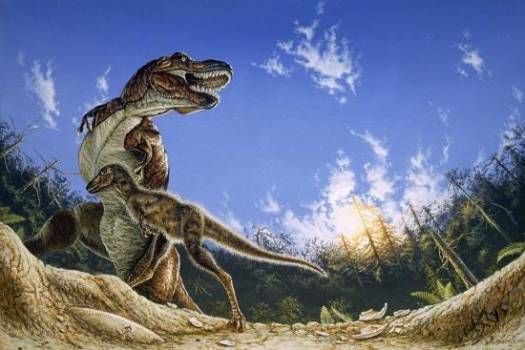
Artwork by Michael W. Skrepnick, showing a mother T. rex with its downy hatchling

I admit it, nine-year-old me would have cried at the idea of Tyrannosaurus rex, my all-time favorite dinosaur, sporting a coat of feathers like a bird.

I first encountered the above illustration in an issue of National Geographic back at that tender age. The issue had a whole article on then-recent discoveries of dinosaur fossils sporting impressions of feathers from China, with numerous model reconstructions and other artwork depicting how the animals would have looked in life. Mind you, I was already aware that some theropod (or “meat-eating”) dinosaurs were close relatives of modern-day birds, and that the “first bird” Archaeopteryx demonstrated a visible link between the two groups. What the new Chinese fossils demonstrated was that the prevalence of feathers among theropods went beyond Archaeopteryx and its immediate ancestors and covered groups once thought to be scaled like other dinosaurs, such as dromaeosaurids (“raptors” such as Velociraptor and Deinonychus), oviraptorosaurs (Oviraptor), and compsognathids (a family including, well, the tiny Compsognathus).

Seeing Velociraptor, the intimidating antagonists of Jurassic Park, portrayed as feathered like birds was already enough to ruffle my feathers (pun very much chosen with intent). But the most offensive illustration in that issue by far, in my juvenile eyes anyway, was the one suggesting that Tyrannosaurus and its cousins in the tyrannosaurid family would have possessed a feathery coat as well. It didn’t matter that the illustration contrasted a downy hatchling with its scaled adult. The very idea of my favorite dinosaur, lord of the jungle of Late Cretaceous North America, ever having the telltale body covering of a lowly, cowardly bird seemed a major downgrade. It was heretical enough to put me off the idea that any dinosaurs evolved into birds at all.

Twenty years have passed, and I have matured enough to recognize that some so-called “non-avian” dinosaurs did, indeed, have feathers, and that all of today’s birds represent an offshoot of these dinosaurs. The preponderance of evidence so far does suggest that, contra the Jurassic Park movies, that dromaeosaurids like Velociraptor would have been feathered by default, as would the flock of Gallimimus seen in the first film’s stampede scene (at least as shown by new fossils of its cousin Ornithomimus). I cannot dispute this, nor do I even mind it anymore.

My feelings about feathered tyrannosaurs, on the other hand, have come full circle. Beginning in the early 2010s, I have warmed up to the idea and was eagerly drawing full feathered coats on them between 2012 and 2013. It was after that period of my life that my skepticism of the concept returned. In the years since, I have lost any remaining love for it and, if anything, have grown even more sick of it than I ever was as a child.

This time, however, I have good reason to believe that neither Tyrannosaurus rex nor the other members of the family Tyrannosauridae ever had feathers. And not only because they look better without them.

Continue reading “Why Tyrannosaurs Probably Didn’t Have Feathers After All”

Breakout for Home

Big Ben, one of the characters from this story

Philip J. Covington, CEO of Global Petroleum Inc., smirked when he strutted out of his limousine and laid his eyes on the new museum. It amused him how literally his contractors and architects had taken the word “museum” when designing the place. The building’s Romanesque portico of marble columns, gleaming silver from the moonlight, seemed more evocative of a prestigious old museum nested deep in his native London than a solitary edifice erected in the central Texas heartland. They had even gone so far as to decorate the premises with trimmed hedges and topiaries to reinforce the illusion of prestigious aristocracy. Or perhaps those were meant to disguise the distant landscape of prairie and pipeline tracks.

Not that Covington truly had a problem with any of it. He would rather feel at home than be reminded that he was in the rustic middle of America.

There was one feature he noticed that contradicted the structure’s predominantly Neoclassical pretensions. Poking up from behind the museum’s main body was the dazzling summit of a glass dome. Covington did not remember arranging for anything like that when he first ordered the building’s construction.

“Mr. Covington! You’re even more on time than I expected.”

Elias Marshall hurried down the museum’s front steps and offered his plump hand for a shake. Except for his weathered suntanned complexion, the Texan local appeared as a figure of glossy white, from his three-piece suit to his cowboy’s hat and boots of faux snakeskin down to the holster for his revolver. Even his hair had turned white to match his fashion sensibilities. It was all in stark contrast to his pale-skinned, dark-haired, and black-suited superior.

“That would be Sir Covington to you, Mr. Marshall,” Covington said, placing special emphasis on his English accent for the American’s hearing pleasure. “But I must say I admire what you’ve assembled together so far, at least from the outside. A bit incongruous with its surroundings, but I suppose a place like this could use a bit more, shall we say, class?”

Marshall chuckled with a slight touch of nervousness. “Trust me, sir, you haven’t seen what we’ve got in store inside.”

Covington was about to shake Marshall’s hand when a faint, prolonged moan reverberated from somewhere, followed by the apparent rattle of window panes. The noise reminded him of a whale’s song, except it eventually trailed into a rumble more like an elephant’s. At least it was a more pleasant sound than the country music his limo’s chauffeur had been playing all night.

“What the bloody blazes was that?” Covington said. “Some sort of machinery?”

“No, that’s from the big greenhouse we have behind the museum.” Marshall pointed over to the peak of the glass dome. “A little surprise we planned for you. The kids should love it way more than any of our other exhibits, for reasons that shall become obvious. May I give you a sneak peek tonight after our little tour, Sir Covington?”

Covington nodded. “Why not take me there straight away? I’ll inspect the rest later.”

Together they went through the museum, following corridor after corridor that lit up automatically with their entrance. The exhibits they passed ranged from diagrams explaining how fossilized marine organisms became petroleum over millions of years, models depicting the process of extracting, refining, and transporting the oil, and then screens and walls of text explaining how the new pipeline nearby would be far safer and more environmentally friendly than those silly tree-huggers, social justice warriors, and restless “Native American” savages would have the public believe. Of course, the language the displays used was far more politically correct, but Covington had always wished he could throw far viler terminology at those troublemakers.

The last hallway he and Marshall went down ended with a closed doorway twice as high as the rest, framed by blocks of dark stone that tapered towards the top for an almost Egyptian-looking slant, unlike the straight Greco-Roman pillars that prevailed elsewhere in the establishment. Little braziers mounted on the sides flickered holographic flames while the entablature above had bold red letters impressed into it that read, “Welcome to the Fossil Age”.

Covington snickered. “What do you have in there, Godzilla?”

“Not quite, sir. Just wait and see.”

Marshall clapped his hands, and the doors opened with a grinding sound effect playing alongside a looping track of tribal drumbeats. Out wafted a gust of humid and balmy air that carried with it the fragrance of tropical flora together with the mustier odor of decaying leaves.

They passed through the open gate onto a wooden walkway held up on stilts over the ground, with pairs of tiki torches providing genuine firelight along the railing. Overhead arced the dome of glass that Covington had seen earlier, but only upon entering its interior could he appreciate its vast and towering scale. The space it enclosed would have easily dwarfed the rest of the museum! Speakers hanging interspersed between the glass panes played the unending chorus of a primordial wilderness, with bird-like squawks and screeches punctuating the chirping of nocturnal insects.

And then there returned the echoing moan Covington had heard earlier, but louder and deeper than before. His flesh trembled all the way down to the bone.

Beyond both sides of the walkway grew a verdant savanna of ferns with scattered cycad, tree-fern, and monkey-puzzle trees. Dragonflies fluttered around little ponds fenced with horsetail reeds while flies buzzed over balls of wet rock mottled with white fluid and shreds of leaves. At least Covington hoped those were only rocks. They had more than an uncanny resemblance to bird droppings and exuded a much more potent, pungent odor.

“You sure spared no expense on the scenic authenticity, Mr. Marshall,” he muttered. “I could’ve sworn those were real dung.”

“Oh, those are real, all right.” Marshall pointed up ahead, where the path ended in a circular plaza like a cul-de-sac. “Look over there.”

Covington squinted past the railing on the walkway’s end until he caught a glimpse of a broad and scaly surface rearing up from the other side, shimmering like a wall of pebbles from the torches’ light. As he traced the contours of the form before him with his eyes, he could hear the crackling of soil beneath heavy footsteps and the rustle of leaves attached to creaking trees.

His pace slowed to a stagger until he gave into the paralysis of incredulous shock. The only muscles Covington could move were his blinking eyelids.

He could confuse the hulking behemoth for nothing else. The long and tubular neck with a tiny head, the rotund torso supported by four legs like pillars, and the even longer tail that hovered over the ground with the tip twirling like a lasso. All in all, the beast must have surpassed all but the very largest whales in mass.

Covington would have taken it for an animatronic like one would find in countless museums and theme parks around the world. But then, with a smooth fluidity too flawless for any machine, the animal craned its neck up to browse from one of the monkey-puzzle trees.

“What the bloody hell is…that?” Covington forced himself to say at last. “Is that real?”

“Every bit of flesh, blood, and bone in him is real, I tell you,” Marshall replied. “Like you said, we spared no expense. Not even when it was more expensive than the museum itself.”

“I can easily imagine why…but why? Why would you bring a bloody dinosaur, of all things, into this?”

“Why not? We deal in fossil fuels after all. Of course, as you know, most oil comes from tiny sea critters rather than dinosaurs. But if you’re going to win hearts and minds over to your new pipeline, you might as well win them over with the kind of fossil they love. Most of all the kids.”

The dinosaur turned away from its meal and lowered its head right down to where Covington and Marshall stood, examining them with little coppery eyes while sniffing them like a curious dog. Covington froze still again when the creature’s snout brushed against his suit.

“At least it’s the plant-eating kind,” he said. “What do you call them, Apatosaurus?”

“Actually, mate, this one’s a Brontosaurus excelsus. Closely related, but the paleontologists now consider them different genera again.”

It was a woman who had addressed Covington. Her khaki shorts and top hugged her tall and slender, dark brown figure while wavy black hair streamed beside her face underneath her slouch hat. She marched down the walkway up to the Brontosaurus and gave the cracked scales on its muzzle a gentle stroke of her hand as if it were a horse, murmuring soft words into its earhole.

“Sir Covington, I’d like you to meet Charlotte Elanora, a tough Aboriginal gal from down under,” Marshall said. “She led the team to capture our big attraction back in the Jurassic, and now she’s its primary caretaker.”

His primary caretaker,” Elanora corrected him. “I named him Big Ben, after my old man. Ain’t he a handsome bloke?”

“A Brontosaurus named Big Ben…it’s alliterative, at least,” Covington said. “How can you tell his gender though?”

“Easy. You can’t see it so well in this lighting, but the males tend to have brighter purple stripes than the females.” Elanora tapped the nape of the dinosaur’s neck behind its head. “Though if we’re going to keep him penned up here, I think we ought to get him a mate soon. Wouldn’t you want that, Big Ben? A nice and pretty sheila to keep you company?”

Benny rumbled and then let out another of his moaning bellows. The volume of the call almost burst through Covington’s eardrums now that had had gotten so close to the dinosaur.

“Truth be told, I think he’s homesick,” Elanora went on. “Though I suppose he’ll be safer in captivity. You can’t see it from this side, but on his left thigh he has some scratches from an Allosaurus attack. Allosaurus, by the way, is one of the big meat-eating dinosaurs, though they’re a bit smaller and nimbler than the Cretaceous T. rex.”

“Good thing we don’t have one of those in here, then,” Covington said. “Now this is all lovely and magnificent, but don’t you think it might be, well, a bit of a challenge to keep him in this place? We’ve all seen those movies, if you know what I mean. Not to mention, the sheer cost of maintaining a beast that big…”

Marshall wrapped an arm around Covington’s shoulder and laughed. “Like I said, it’ll be the biggest draw we can throw at them. The admission tickets alone should pay for everything. And besides, the Brontosaurus is a gentle plant-eater. What could go wrong with his kind?”

Continue reading “Breakout for Home”

Arrows of Alodia

Maia of Alodia, the protagonist of my short story “Arrows of Alodia”. By the way, Alodia was the southernmost of three Christianized kingdoms that sprung up in Sudan during the Middle Ages, after the fall of the kingdom of Kush.

Japan, 1500 AD
The walls of the castle glowed pale yellow before the face of the setting sun, with blue shingles sparkling on its stacks of curved roofs. This radiance conferred onto the structure the semblance of a tall gold crown encrusted with lapis-lazuli gems. Atop a wooded hill it sat, overlooking the fields, forests, and scattered peasants’ villages like an emperor surveying his rural domain.

A young woman hiked up the series of stone steps which zigzagged up the hill’s northern slope, cradling in her arms a yew chest. Her hooded waist-length kimono and trousers, both dull green like the trees sheltering the path, protected her both from the evening’s damp chill and from any eyes which might be spying on her. Not that the woman had noticed anyone giving her a second glance so far, but nobody in her line of work could afford to let their guard down.

She reached the summit of the hill, strolled across the short bridge over the castle’s moat, and then paused to gaze over the countryside sprawling behind. The verdant beauty of the Japanese landscape would never leave her eyes in entirety, yet years of experience had scraped away much of its original allure. For underneath its lush and tranquil veneer lay a cutthroat and lawless world of cruelty and treachery. This would be the last evening she would spend in this land. The next day, she would set sail for civilization.

Among the irregular mass of rocks which built up the castle’s base, there stood a more rectangular slab as tall and wide as a man. The woman inserted her fingers along its edge and pushed it aside as if it were a regular Japanese sliding door. Ahead ran a narrow corridor lit with paper lanterns hanging from the ceiling, a small courtesy she had not expected.

Underneath the more pleasing scent of the cherry blossoms, there leaked the stink of dead flesh through the chest’s lid. The woman hugged it against her breast, with queasy nausea swelling in her stomach. Grisly as the odor was, it was only part of the price she had to pay for her upcoming escape.

Continue reading “Arrows of Alodia”

The Elephant Joust

The gong rang and reverberated, and the gates to the arena ground open. In rode Huan Xi, Imperial Prince of Zhongguo, on his elephant Longwei. Both he and his mount glimmered with platelets of polished leather armor under the afternoon sun, with bronze blades glinting on the elephant’s tusks. Spreading a proud smile across his pale yellow-brown face, Huan Xi waved with lance in hand to the audience that filled the terraced seating to his right.

Everyone on that side of the arena waved back with cheering and hooting of his name. These men and women were all Zhongguans, Huan Xi’s subjects, come to see him joust for the prize he desired more than anything else. From the lowermost seating there watched the Empress herself, his mother, with a bright pink robe of silk and cherry blossoms in her bun of graying hair. Her eyes twinkled with both Imperial pride and maternal love, but Huan Xi noticed her wringing her hands together with nervous anticipation.

He would make her so proud. This he swore by Zhongdi, Lord of all the Heavens.

Another gong rang from atop the arena’s far end. Afterward there thundered exotic drums as an opposite pair of gates began to part. The right side of the arena fell silent, but the spectators seated along the left erupted into cheering and chanting in a very different language. These other people, dark brown-skinned with brief garments of white linen, hailed from the ancient kingdom of Khamit far to the southwest of Zhongguo. On their lowest seating was their old Pharaoh Kahotep, with his blue- and gold-striped crown and braided goatee. He flashed a smirk in Huan Xi’s direction.

The Prince of Zhongguo searched the Khamitans’ ranks for a glimpse of Berenib, the Pharaoh’s lovely young daughter. It was over her hand that the joust had been arranged, yet Huan Xi could not make her out anywhere. He could not even find her next to her father or any of his officials. From what he knew of her character, she did not seem like the type of woman who would avoid the sight of blood in the arena, but he was at a loss to explain her curious absence otherwise.

Maybe Kahotep had meant to present her only after the event, for whatever reason. Regardless, as long as Huan Xi had the memory of Berenib’s exquisite beauty in memory, he did not need to be reminded of why he fought.

Longwei the elephant raised his trunk with an anxious rumble. Huan Xi patted his brow while whispering the most soothing words he could muster. In spite of their size, elephants could be skittish animals, but the Prince had to wonder what had intimidated his steed all of a sudden.

Continue reading “The Elephant Joust”

Mark of a Muvhimi

Nyarai crept through the tall grass with her hunting bow in hand and an iron ax by her hip. Her tawny halter-top and skirt, both banded with wavy brown stripes, further hid her within the yellowed savanna. Perspiration dripped from her brow, chilling her dark umber skin in spite of the baking afternoon sun.

The other Vavhimi had chosen her too young. No way in Mwari’s name could Nyarai do this and survive.

Ahead of her, the stegosaurs ambled in the field amidst scattered aloe and cycad trees. Any single one of the lumbering giants could feed all her neighbors back in the city, with the pebbled hide providing shields for the Mambo’s royal guard. The pentagonal plates that shimmered like copper on their backs would bring in a fortune from merchants in all directions. So would the ebony spikes glinting at the tips of their tails…if they did not impale Nyarai first.

No, she could not let her fears drown her hope. She was a Muvhimi, a hunter of the Vazhona nation, and she could not let her peers down.

Nyarai slipped an arrow from her quiver and laid it atop the bow, aligning its head with one of the stegosaurs’ rumps. On the far side of the field, the savanna gave way to a woodland of mopane trees where the other Vavhimi awaited. They had sent her not to kill any of the stegosaurs, but to drive the herd into their trap.

It was a simple, classic strategy when described out loud. Nyarai could only plea to Mwari the Creator, and to the spirits of her foremothers, that it would be as simple to carry out.

She drew her bowstring with tender care, not letting it creak. The bow still wavered in her clammy grip. The stegosaurs lowed and grazed, and she prayed in murmurs that they would not smell her.

Nyarai let go.

Continue reading “Mark of a Muvhimi”

The Case for African-American Reparations

This was originally a paper I wrote for a Sociology course over at UCSD back in 2012. Even after the passage of several years, I still consider what I articulate in this paper to be representative of my current views on the topic.

Are Black Americans owed reparations for the oppression they have suffered throughout American history? Many if not most White Americans would say no, whereas many if not most Black Americans would say yes. The question of reparations is a racially polarizing one, and since Whites form the demographic majority and socioeconomically dominant ethnic group in America, this has meant that reparations have never been paid. This payment is long overdue. Since Black Americans have suffered from and continue to suffer today an ancient legacy of racial oppression, a reparations program for them is long overdue.

The most commonly cited objections to reparations for African-Americans’ suffering are that slavery ended too long ago and that many White Americans’ ancestors never owned slaves, therefore absolving Whites as a collective of any responsibility over the issue. The former argument would be valid if slavery was the only historical crime against Black Americans and if modern Blacks did not suffer from its effects, but neither of these conditions have been met. The oppression and unfavorable treatment that Blacks received continued even after slavery was formally abolished and still affects the modern Black experience. As for the second argument, while Whites as a whole may not have been guilty of slavery, they have benefited from a racist social hierarchy that favored them over Blacks. This is not a question of making White people feel guilty about what a few of their ancestors did over 150 years ago. The fundamental issue is one of healing a larger legacy of racism that elevated Whites about Blacks.

Continue reading “The Case for African-American Reparations”

The Battle for Djamba

Our heroine, Queen Butumbi of Djamba, shoots from the back of her tame T. rex Tambwe.

Tambwe craned his big head upward, inhaled through his nostrils, and let out a deep rumbling growl from his mouth of blade-like teeth. The tyrannosaur’s tail swayed behind him as he sat crouched within the wall of jungle that reared alongside a moss-stained road.

Butumbi, Queen of Djamba, stroked the deep green scales on her mount’s neck while murmuring an incantation to calm his temper. She could hear the giant predator’s stomach grumble with a hunger for fresh meat that had grown over the past week’s southward march. With a voice as soft as that of a mother reassuring her child, the young Queen promised Tambwe that he would have more than enough to gorge on before sundown.

Other than the normal chorus of bird squawks, insect chirps, and monkey hoots, the jungle lay silent on both sides of the road. Even from atop the saddle behind her tyrannosaur’s neck, Butumbi could see little of the force she had laid out before her. Armed men and women lay beneath the cover of undergrowth and creepers, as did the packs of feathered deinonychus that had been hired to protect their flanks. Only the tiniest glint of iron weaponry and jewelry of gold and copper could betray anyone’s presence.

It was as Butumbi had planned. The forces of Ntambwa would not know what struck them until it was too late.

Continue reading “The Battle for Djamba”

Staff of the Red Sun

An illustration I did for my short story “Staff of the Red Sun”.

Egypt, 1942 AD

The limestone door ground over the gravelly earth as the diggers pushed it open. The grating noise would not have been the most pleasant for most men to hear, but for Friedrich von Essen, it was music to his ears. After untold weeks of watching these chattering Arabs gouge a pit out of the desert beneath the roasting sun, he had found it at last.

The thought of presenting this discovery to those fools back in Berlin made him smirk with glee. Even the Führer himself, eager as he was for any leverage in the war, had shown a bit of hesitance before sponsoring the expedition. Even if Friedrich ended up finding nothing inside this tomb, he had at least confirmed its very existence.

A faint yet acrid smell flowed out from the black depths beyond the doorway. The Arab diggers jumped back with startled shouts and whimpered among themselves, their normally bronze faces slightly blanched.

Underneath the howl of the wind, Friedrich thought he had heard a soft whisper. It must have been one of the dozens of men behind him, but it did make the back of his neck prickle.

“What do those inscriptions say, Professor von Essen?” Colonel Hermann Schmidt pointed to the string of hieroglyphs chiseled into the entrance’s lintel.

“Oh, those simply identify the tomb as belonging to Nefrusheri,” Friedrich said. “Why?”

The colonel’s tanned face had turned a shade paler as well. “I only wanted to make sure it wasn’t something like a curse.”

“Oh, don’t believe such sensationalist rubbish. Curses aren’t as common on Egyptian tombs as you think. You might find a few in tombs from the Old Kingdom, but that’s about it.”

“Fair enough, Professor. I would’ve expected a fearsome sorceress like your Nefrusheri would have something protecting her resting place.”

Friedrich glanced back at the darkness within the tomb. If the departed sorceress truly possessed the sort of power he sought, it would seem strange if she had not taken measures to defend it somehow. What those would be, he could not even guess.

On the other hand, he could not let fear and paranoia keep anyone away. Not when there was a war to win and a world to conquer.

“In case she does, bring your men over here,” Friedrich said. “We’ll go in together.”

Continue reading “Staff of the Red Sun”