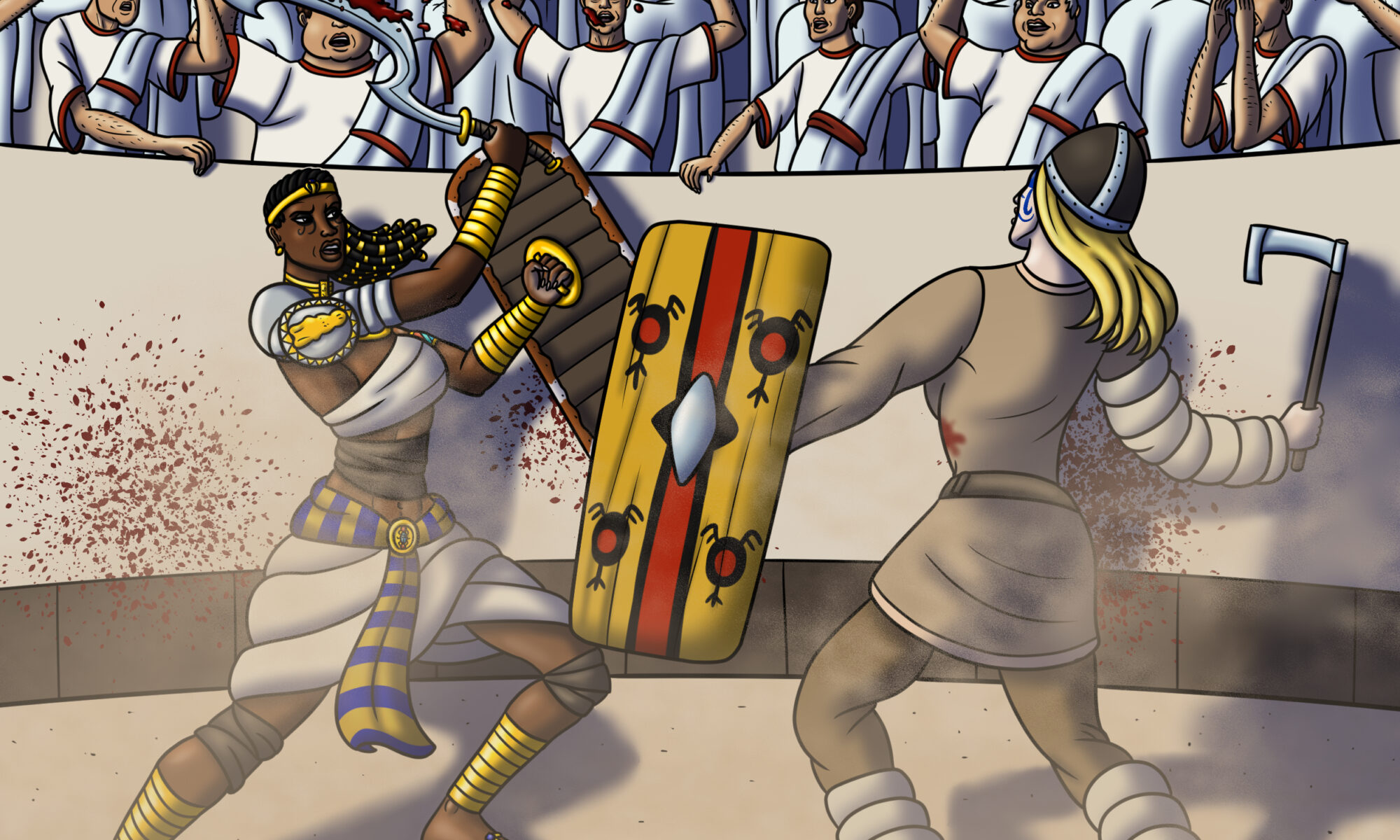
Punishment

Trumpets blared like the cries of elephants, and drums cracked louder than a thunderclap. The populace of Waset, capital of Egypt, poured out from their mudbrick houses to gather alongside the cityโ€™s main avenue. Fathers hauled their sons onto their shoulders, mothers let their daughters stand beside them, and youths stepped aside to make way for the elders on their walking sticks. Shaded by palm trees and the rearing statues of gods and past rulers, the people waited with buzzing eagerness for the processionโ€™s arrival.

None of them looked behind to notice the white-robed stranger.

Continue reading “Punishment”

The Battle Roar of Sekhmet

Egypt, 1350 BC

I entered the sanctuary area at the back of our hut with a bowl of gazelle meat. Beside me, my little niece Nebet hugged her miniature drum as if it were a doll. The likenesses of our forefathers and mothers watched our passage with painted eyes, their altars adorned with weapons and the gold flies their valor had earned them in life. But it was the gilded likeness of Sekhmet, she of the lion mask and blood-dyed gown, who awaited our arrival against the wall. Despite the dimming of the sunlight through our hutโ€™s narrow windows, Sekhmetโ€™s amber eyes blazed with the same fire that had emboldened generations of our ancestors.

Many times I had knelt before her as I did now, lighting the meat I laid at her feet. The scent of its burning recalled battle after battle of blazing tents and enemies being speared, shot, or cleaved into pieces. The warmth channeled the sunโ€™s blazing heat, which glossed my dark brown skin with perspiration. Even the crackling of flesh breaking down into ash became the cracking of bones and shields as I yelled the battle roar of Sekhmet in my memories.

This evening I would consult our matron for a different battle. This time, our enemies were not Kushites with ochre-reddened hair and leopard-belted kilts. Nor were they easterners like the Hittites or Babylonians, with pale skin and loosely curled beards. No, they were Egyptians like us, fellow children of the Black Land who had fallen under the influence of the false Pharaoh Akhenaten.

Already they had dragged little Nebetโ€™s father away to slave away in the lair that tyrant had built for himself and his cult of lies. I did not even want to guess what his minions had done to her mother. Only I remained to protect and teach the girl over the past year, and never would I let her suffer the same fate as her parents.

I gave her a nod and she pounded her drum with more unbridled passion than a temple ensemble. Together we sang our prayer for Sekhmetโ€™s vigilance, for her guidance, for the courage with which she would imbue us in the face of war and persecution. The fire on my offering continued to flicker on our ancestorsโ€™ faces as their spiritsโ€™ voices joined ours in a greater chorus. The thumping of my heart became a rhythm complementing Nebetโ€™s drum, as did the war drums that had thundered before all my past battles. Alongside the musicโ€™s growing fury there rose an energy within me that flamed as hot as Sekhmetโ€™s gaze. As she opened her jaws to bare her fangs in my vision, so did I.

It built up from my breast to my throat, ready to be released over a climax of cracking drums and shrieking cries.

Instead came the hoarse bray of a royal trumpet. Then followed silence, and finally the rapping of a bony knuckle on our door.

Continue reading “The Battle Roar of Sekhmet”

Tyrant Lord

North America, 67 million years ago

The sunriseโ€™s golden glow drifted across the rolling sea of treetops. It descended through the canopyโ€™s tangle of leaves, branches, and vines in scattered beams until it reached the forest understory. Within this maze of trees and tropical underbrush slept a giant.

A hide of black and dark green scales camouflaged his nine-ton bulk amidst the shadowed foliage until he cracked his flaming yellow eyes open. With the help of short yet brawny double-clawed arms, he propped himself off the forest floor onto even stronger hind legs, with his thick long tail hovering behind. He shook his head, stretching his neck muscles, and took in a great yawn with jaws lined with ivory spikes. Inside his cavernous stomach grumbled hollow.

He wasย Tyrannosaurus rex, tyrant lord of the jungle, and he had awoken hungry.

He craned his head up to scan his surroundings. Six monsoons had passed since he had carved his territory out after leaving his motherโ€™s brood, and he had since mapped out its every tree, bush, and stone in his memory. He recognized that the ancient kapok tree he had rested underneath last night stood a few hoursโ€™ walking north of a river fed by waterfall, where game would gather to cool off once the heat reached its noontime peak. Between then and daybreak, they would browse the jungle glades for their morning meals.

And the tyrannosaur would make his own breakfast out of them.

Continue reading “Tyrant Lord”

Why Europeans are Almost 1/3 African

Did you know that European people can attribute almost a third of their ancestry to additional migrations out of Africa?

It should be common knowledge by now that human beings in their modern form, Homo sapiens, first evolved in Africa. Exactly when we emerged on the scene remains uncertain (recent fossil discoveries suggest it may have happened over 300,000 years ago, a hundred millennia earlier than we originally thought), but whenever it was, most of our speciesโ€™s history of existence would have played out on the so-called โ€œDark Continentโ€. It would have been no earlier than 70,000 years ago โ€” and possibly as soon as 55,000 years ago โ€” when the ancestors of all people outside of Africa would wander out of the continent and colonize the rest of the habitable world.

This would not have been the first dispersal of hominin apes out of Africa, mind you. Much in the press has been made of the fact that between 1โ€“7% of modern human ancestry outside our ancestral continent comes from the descendants of earlier emigrants such as the Neanderthals and Denisovans. What may not be so widely publicized, however, is that the famous โ€œOut of Africaโ€ migration between 70โ€“55,000 years ago would not have been the last movement of Homo sapiens from Africa into Eurasia and beyond, either. There is, in fact, a plethora of compelling evidence that humans from Africa continued to venture out and leave a permanent genetic mark on the ancestry of their Eurasian kinโ€” even the โ€œwhiteโ€ peoples of Europe.

I donโ€™t mean a light dash, either. Almost one third of European ancestry descends from African admixture within the last 55,000 years.

Continue reading “Why Europeans are Almost 1/3 African”