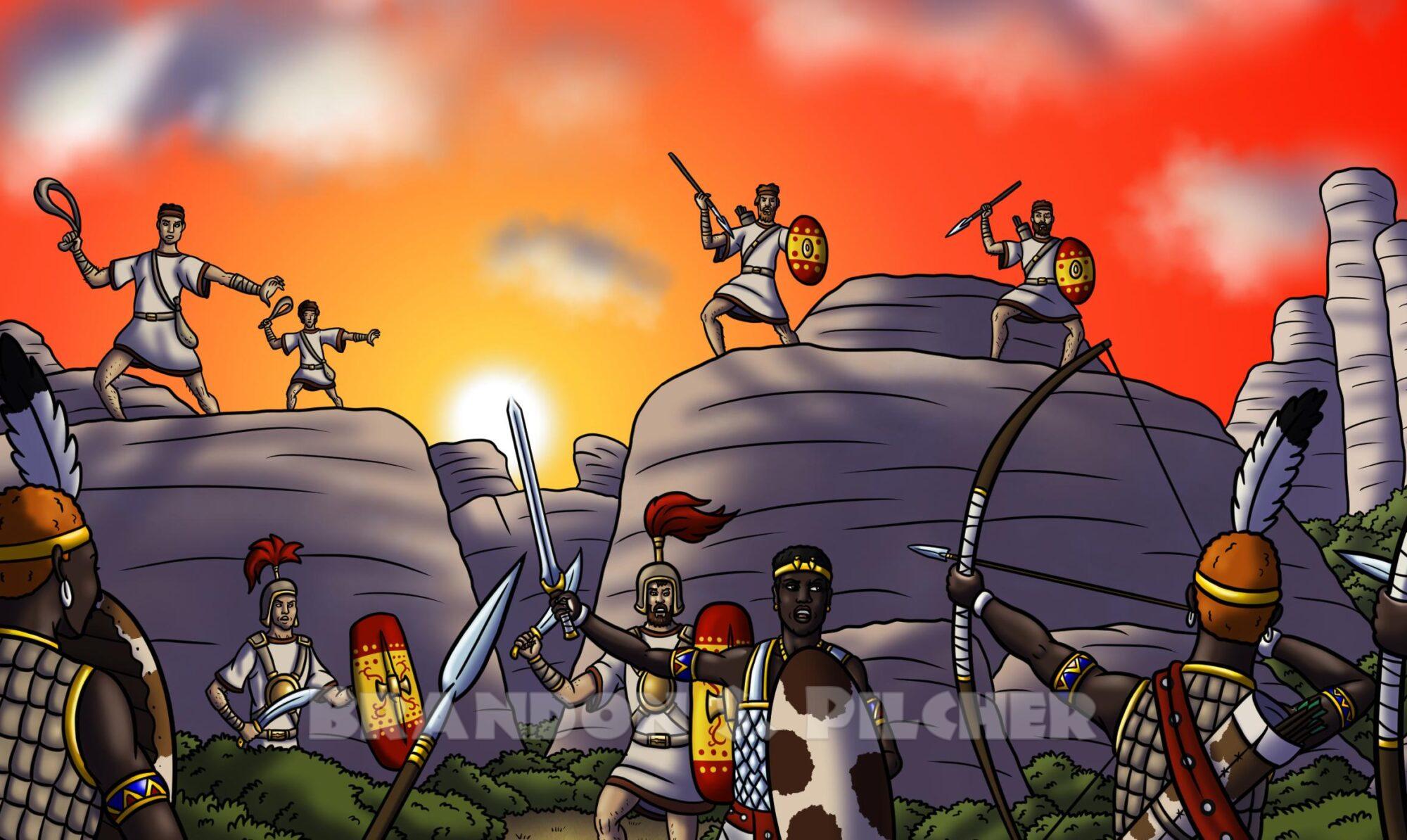

The following is a sequel to my earlier story Arrows at High Noon, starring the characters Alara of Kush and his companion Ismail.
10 AD
Alara brushed the lichen off a leaning pillar of stone. The inscription he revealed, weathered by centuries of rain and wind, was chiseled in the old Hebrew alphabet which he had never learned to read. Something above the text that he did recognize was the symbol of a six-pointed star surrounded by six dots within a circle. They called it the seal of Solomon, the king of old Israel.
Studying the map of yellowed papyrus he had inherited in his youth, Alara compared the terrain it depicted with the hills of wheat-brown grass and scrub that surrounded him. The match was impeccable despite the passage of nine centuries since the map’s drafting. With a smile, Alara returned to the dirt path where young Ismail awaited with the donkey carrying their supplies.
“We should be almost there,” Alara said. He pointed to an edifice of cliffs poking up from the hills to the northeast. “My bet’s on the treasury lying there.”
“Praise all the gods,” Ismail replied as he treated himself to a drink from his waterskin. “The less we need to walk, the better for my leg.”
Nine years had passed since Alara found the orphan begging on the streets in a town along the northeastern coast of Arabia. In that time, the boy had grown tall and lean, with a leg of wood taking the place of the one he had lost. Of course, as Ismail grew, his wooden leg had to keep pace, and those wooden legs were not cheap in Alara’s experience.
Ismail turned his head around with a hand hanging over the dagger under his belted sash. “What if the Jews catch us stealing from their old king, my sayyid?”
Alara scanned the hills with his eyes as well, noting a cluster of square houses glowing white from the sunlight within a distant valley. “They shouldn’t. It’s been nine hundred years. Even the people of Kemet are known to dig into their own tombs from time to time. As do some of my fellow Kushites.”
He squinted at a tiny brown shadow that dashed within a patch of carob trees between them and the village. It must have been a gazelle. These hills near the Galilean Sea in Judaea teemed with the little antelopes. Still, one could never be too careful out in the countryside anywhere.
The shadow did not appear again. Alara shrugged. “If any of the locals do have a problem with us, we can’t stand out here forever. Let’s head on to that treasury!”
Up and down the dirt path they hiked, with the joints of Ismail’s wooden leg clacking while he limped. More pillars with Solomon’s seal inscribed into them stood strewn along the way. Alara wondered if any of the Jews were still able to read their ancestors’ old writings, given that Aramaic had supplanted old Hebrew as their main tongue in the centuries since. Could they even recognize the seal of Solomon themselves? Alara’s knowledge of it had been an ancient family secret like the map that had led him here.
A patch of bushes rustled along the path. Out pounced a youth around Ismail’s age in a dusty brown tunic whose carpenter’s knife glinted sharp in the evening sunlight. His lips curled into a doglike snarl within a bronze-skinned, black-bearded face.
In Aramaic the young man growled, “Give me everything you have, or else!”
Alara unsheathed his iron sword, the blade of which ran so much longer than the youth’s makeshift weapon that it wasn’t funny. “You don’t want to do this, trust me!”
The Jewish youth brandished his knife. “I have no choice!”
“Why not?” Ismail asked. “Why must you do this, my Jewish friend?”
“That’s none of your concern, you Arab heathen! I won’t ask again. Give me everything or I’ll skin you and that dusky companion of yours alive!”
Alara smirked. It would always amuse him how the Jews, Arabs, and other peoples in the west of Asia loathed one another, given he could barely distinguish their appearance or language. Then again, given how his own Kushites had fought with the Kemetians and other neighbors on their own native continent, perhaps he was in no position to judge.
He jabbed the tip of his sword into the skin of the Jewish youth’s neck, just shy of drawing blood. “I admire your ferocity, if not your wisdom, young man. Consider, though, that we outnumber you two to one.”
Ismail pulled out his dagger. “And just because I lost a leg doesn’t mean I can’t fight back.”
The boy retreated a step with his face a shade paler. The knife shook in his loosening grip. “Listen, my family and I have lost everything we had. Without this, we’ll all die.”
“Lost everything?” Ismail asked. “Sounds like myself when I was little. What, may I ask, happened to your family?”
“Times have been bad for many people in my village over yonder.” The youth directed his gaze to the village in the faraway valley. “We turned to the priests for help, but that only made it worse in the end. If we do not pay back what we owe them, they will have us all put to death.”
Alara felt a warmth melt his heart inside. This young man’s struggle was all too familiar to him, bringing up memories that had tormented him since he had to leave Kush. “Your priests are much like ours, I see. I daresay they are the worst robbers of all.”
“Thank you for your sympathy, but it won’t buy them off,” the Jewish youth replied. “I ask one more time. Give me everything you have, or—”
Ismail’s eyes lit up. “What if I told you where we are headed? You’ve heard of the old king Solomon, haven’t you?”
“Yes, my father and father even claim we descend from him, but I never believed that. What of it, Arab?”
Alara withdrew the sword from the young Jewish man’s neck and pointed it again at the cliffs to the northeast. “We believe he hid his most precious treasure somewhere over there. I imagine even the smallest cut would more than cover your debt.”
The youth lowered his knife with a cock of his eyebrow. “How would you know where it would be? I’ve heard of that secret treasury, but nobody knows where it is.”
“Nobody here in Judaea, maybe, but my family does.” Alara unfolded the old map before the Jewish boy. “Our ancestress the Kentake, or Queen, Katimala had this drawn nine centuries ago. They say she not only met Solomon himself, but became his lover. Even bore him a son.”
The young man’s eyes widened as they ran up and down the map. “My mother has told me the queen of a place called Sheba was our ancestress, but again, I never believed it. But considering nobody knows where Sheba was, other than somewhere in the far south…”
“Could it not be Saba in the south of Arabia?” Ismail asked.
“It matters not in the end,” Alara said. “Solomon, I understand, had many wives and other women. What matters is that, if you put away that knife of yours and come with us to the treasury, you won’t need to rob anyone ever again. Is that an offer you’ll accept?”
The young Jewish man blinked twice in a moment’s pause. He slid his knife back under his tunic’s girdle. “I accept your offer. Please forgive me for attacking you.”
Alara smiled. “As they say, forgiveness is divine. Now, may I have your name? I am Alara, and my Arab companion there is Ismail.”
“Shlama to you both, and call me Yeshua. But we must hurry. The priests’ men come to collect their debt before sundown today. If we are not able to pay them in time…”
Alara patted Yeshua on the shoulder. “Even if we are late, I’m sure we can take care of those brutes.”
Yeshua turned to look at his village again with a gulp. “I sure pray that you are right, Alara of Kush.”
The sun was hovering close above the western hills when the three reached the cliffs. Here the path crooked into a defile so narrow that they had tether their donkey to a juniper tree outside and then slip through one by one. The wailing evening wind filled that dark ravine with a chill sharper than any Alara had felt in all the desert nights he had shivered through. He knew from years of experience that the accounts of ghosts and ghouls guarding ancient treasures were no more than stories meant to entertain children, but again, one could never be too careful in these remote places.
“Are you sure you know the way, Alara?” Yeshua asked. “We’re running out of time!”
The young Jewish man’s voice bounced between the cliffs like the cries of demons from the underworld beneath. The little hairs on Alara’s neck bristled.
“And this terrain is wearing down my legs,” Ismail added. “Both my wooden one and my flesh-and-blood one.”
Alara gave his map a closer examination, running his finger along the jagged line of black ink marking the supposed path to the treasury. As reliable as it had been so far, there always remained the risk of error. The Kentake Katimala, or the scribe in her employ, could have misremembered a detail here and there. Or they might have drawn the path simpler for ease of reading, omitting some key twists and turns. Even a map that had been accurate nine centuries ago could not account for rock slides or other changes in the earth that could block or alter the way.
Ismail whistled. “There’s a fork in the path. Which way?”
Alara did not see any fork drawn on the map. With a confused grunt, he looked up to see that his companion had spoken the truth. The ravine did indeed split into two before them, one veering to the left and the other to the right.
“Satan’s trickery be cursed!” Yeshua said. “Which way does your map say we should go, Alara of Kush?”
“It doesn’t say, but we might find out if we split,” Alara said. “I’ll take the left, you and Ismail the right. We’ll return here once either party has found something.”
Alara went down the fork’s left branch. It was even less spacious than the defile before, forcing the Kushite to squeeze himself between rough walls of cold rock. It was too easy to imagine the crevice crushing him in a sudden closure were an earthquake to happen. Small wonder so many people found such tight spaces intimidating!
To his relief, the path through the rock widened again. What was not to his relief was the dead end ahead. Alara could not make out the outline of a door in that empty wall of rock, nor even the most faded inscription of Solomon’s seal anywhere. All he could spot was a faint yellow gleam among the rubble littered on the floor.
He picked it up. It was a rod of gold with sharp prongs sticking up from one end. A chamber’s worth of ancient treasure it was not, but neither was it nothing. A strange gold trinket had to have been worth something at the nearest bazaar.
Alara squeezed his way back to the fork’s base to find both Yeshua and Ismail having come back. With a gasp, Yeshua locked his eyes onto the gold rod in the Kushite’s possession.
“I knew the key had to be somewhere!” the Jewish youth said.
“This thing is a key?” Alara asked.
“Of course! The Arab and I found the lock down the path to the right. Come with us!”
Alara followed them down the rightward path until they reached another wall of rock at its end. This one had a thick disk of gold mounted on it with the familiar seal of Solomon incised into its face. Through the rock around the disk ran the rectangular outline of a pair of doors that stood a little higher than a man was tall. The thin gap that separated the two doors ran beneath the disk.
Alara looked up to the sliver of orange sky above the ravine and whispered thanks to the gods, most of all the supreme Amun, for their change in fortune. “This is a lock?”
Yeshua tapped his finger on a hole in the disk’s side. “My family and I are carpenters. We’ve made many locks like these out of humble wood. Please, hand me the key!”
After Alara gave it to him, he inserted the gold key into the lock and gave it a turn. Afterward he pulled out a bolt of gold from the lock’s side. Next he gave the disk a tug, and it split apart while the stone doors ground open with a screeching resonance.
Together, they gasped. After it had laid hidden in the Judaean hills for nine centuries, they had opened the secret treasury of King Solomon at last.
It was dark inside, but enough gold, silver, lapiz-lazuli, and other precious materials glimmered through the blackness to reveal at least a fraction of the riches the Israelite king had stashed in there. Alara laughed with glee as he dug his fingers into a pile of gold ingots that lay on the floor. After him limped Ismail, who plucked a collar of brightly colored stones off the nearby idol of a forgotten god and plopped it onto his own neck.
“A handful of this would more than satisfy your priests, Yeshua,” Ismail said. “And leave some for you and your family for the rest of your days.”
For his part, Yeshua drifted toward a long chest of ebony inlaid with gold and ivory. He pried it open with his carpenter’s knife to reveal a khopesh sword with a curved sickle-shaped blade of spotless iron. The way the khopesh’s luster reflected in the young man’s eyes reminded Alara of himself receiving a new toy when he was a boy.
Yeshua raised the sword from the chest and ran his finger along its cutting edge. “I cannot believe this hasn’t rusted over the centuries!”
“It has been in that chest sealed from the elements for a long while,” Ismail said. “You aren’t going to use it on anyone, are you?”
“Um, only if I need to…”
“Which shouldn’t be often,” Alara said. “It isn’t like you’ll need to rob anyone with it.”
Yeshua held the khopesh close to himself. “What if I do?”
“I know your struggle all too well, but you shouldn’t go around robbing people anyway, Yeshua,” Ismail said. “You wouldn’t be any better than the priests troubling your family. How would you like it if you were robbed yourself?”
Alara nodded. “As the old saying goes, don’t do unto others what you wouldn’t want done unto you. That said, there might lions or wolves prowling on the way back to your village. I’d keep it for that reason alone.”
“You’re right,” Yeshua said. He slipped the khopesh under his girdle. “Speaking of my village, we have to head back. Sundown must have passed already!”
Alara’s face took on a chill. “Then we must grab what we can and hurry out as fast as possible!”
It was to Alara’s horror that the sun had sunk halfway into the western hills when they exited the defile in the cliffs. Even more frightening was the semicircle of men wielding spears that awaited them outside. Among these temple guards sneered a white-bearded priest in a turban with a bejeweled breastplate over his double tunic of blue and white linen.
The priest thrust a bony finger like a spear of his own at the three. “Yeshua ben Yosef, I figured you’d be digging for your ancestor’s treasure in these hills. Your family’s already overdue. Come back home with us, and we’ll have your sentence arranged.”
“How did you know Solomon’s treasury lay out here, old priest?” Yeshua asked. “Or that I was his descendant?”
“The servants of Elohim know everything, son of Yosef. Though it may be that that Kushite man beside you helped figure it out. His ancestors’ queen is also your ancestress, after all.”
“You’re right, and it happens she’s my ancestress too,” Alara said.
“I know you priests keep many records,” Ismail asked. “But how would even you know we were out here tonight? Were you tracking us down?”
“We were, for we need his whole family together to carry out their sentence,” the priest answered. “I trust you can discern what that sentence would be.”
Alara pinched up one of the gold ingots he had smuggled from the old treasury. “There’s no need to sentence him now. We’ve more than enough of your late king’s treasure to cover his debt. Why, we might even take you to where the rest of it lies so you can help yourself.”
“We know where it is, my Kushite friend. We even know where we hid the key long ago. It does not matter. His family failed to pay before due, so they must pay with their blood!”
Yeshua whipped out his new khopesh. “How about you’re the one who pays with his blood, you old jackal!”
Alara unsheathed his sword as well. Even Ismail got his dagger out.
The priest’s thin wrinkled lips creased wide. “Very well, if you wish to fight your sentence, let us fight. Guards, attack!”
The guards closed in. The one in the formation’s center jabbed his spear at Alara. The Kushite chopped his sword through its wooden shaft. A second spear punctured his shoulder. Alara’s legs buckled under the intense pain that went through his body from the wound. He slashed at his attacker and missed. The guard thrust again, the edge of the spear’s iron point slicing across Alara’s breast even as he dodged.
Another sweep of iron flashed before him, followed by a burst of bloodshed. It was Yeshua’s khopesh cleaving off the guard’s head. The young man’s battle roar rekindled Alara’s own, and the pair hacked away at the circle of guards which entrapped them. Splinters of spears split in two flew everywhere along with the droplets of scarlet gore.
Yeshua yelled shriller than before and fell to the ground with a red mark smacked onto his brow. Alara bolted to his rescue until two guards blocked his way with crossed spears. A third guard’s stinking breath washed onto his neck from behind. Spinning on his feel to face the man, Alara found the charging guard’s spear zooming straight for his breast.
An Arabian dagger whirled into the guard’s iron helmet, knocking it off while leaving him stunned. Alara took advantage of his daze by ending his misery with a sword’s plunge through his open mouth. Over the chaotic clamor, Ismail yelped a cheer while brandishing his fist from the fray’s edge.
One of the remaining guards batted his spear into Ismail’s wooden leg, toppling the young man over, while a fallen Yeshua was rolling over the blood-slicked battlefield to evade the other guards’ downward attacks. The crack of the old priest’s cackling was louder than the battle itself. He was enjoying this carnage like Roman citizens at the amphitheater!
Possessed by disgust as much as rage and pain, Alara swiped his sword’s tip across the priest’s neck. Above the red river cascading from his gash, the cruel old man’s face became a pale, open-mouthed mask of shock while he crumpled to the ground.
The guards who were left halted in mid-stroke when their master’s croak of death rang out. They had nobody standing who could give them further orders. Away from the battlefield they ran into the night like the cowards they were. Alara was tempted to unsling his old bow to pick them off with his arrows, but he had worn and bled out too much of his strength to do so.
After he retrieved Ismail’s dagger and helped him back onto his footing, the Kushite found Yeshua kneeling over the slain priest’s body with his hands pressed together in prayer. The Jewish youth’s face had lost all color while tears glossed his cheeks.
“Forgive me, Elohim, for what I have done,” Yeshua cried. “This was all my fault!”
Ismail faltered on his wooden leg between the guards’ corpses to lend a hand to him. “Do not blame yourself, my friend. It wasn’t even your blade that slew him.”
“But I did slay many others. Never before have I taken any man’s life, and now I have taken more than one. If I had known it would be so, so horrible…”
Alara crouched beside Yeshua and laid a hand on his shoulder. “We all feel that way the first time. I can’t say it gets much better afterward.”
“Then never shall I kill again,” Yeshua said. “Not even an eye for an eye. From here on, if another man so much as slaps me, I won’t even slap back. Why, I might even give them the other cheek.”
“That’s going a bit too far, if you ask me,” Ismail said. “But at least you learned something from all this.”
Alara pulled out a fistful of his gold ingots and showed them to the young Jewish man. “If nothing else, you should come home with these. Your family will need it to get by.”
Yeshua picked out only three of the ingots. “These will be more than enough for us. The rest I’ll give to those who need it more than we do. And I won’t expect anything back from them. As for the rest of the treasure, it shall be all yours. Kasha lak, Alara of Kush. Goodbye.”
Alara and Ismail watched as Yeshua ben Yosef tossed away his bloodied khopesh and staggered down the path into the darkness beyond.
“I do wish him well, sayyid,” Ismail said. “But I fear those priests of Elohim won’t take well to this.”
“May all the gods curse their priests everywhere,” Alara muttered. “Sometimes, I think it would be easier for a camel to go through a needle’s eye than a priest to earn the gods’ approval. At least it would if the gods truly cared about justice.”
“In all honesty, there are moments when I question if there are gods at all. So much misery happens under their watch that they don’t do anything about.”
Alara turned back toward the defile in the cliffs. “In fairness, there are blessings here and there too. Besides, I’m spent for the night. We should have enough to afford a good night’s lodging, and maybe some chilled beer. What say you, Ismail?”
“The sooner the better. May I ride the donkey for the rest of the night? My good leg cannot take any more.”
“If the donkey can handle your weight, why not?”
So preoccupied with the promise of refreshment was Alara that he did not take another glance in the direction of King Solomon and Queen Katimala’s lost treasury.